Broken spring
A separated torsion spring may leave a visible gap in the coil, while a failed extension spring may hang loose beside the horizontal track. The opener should not be used to lift a door whose spring system has failed.
Serving Flagler Beach, Florida & surrounding areas
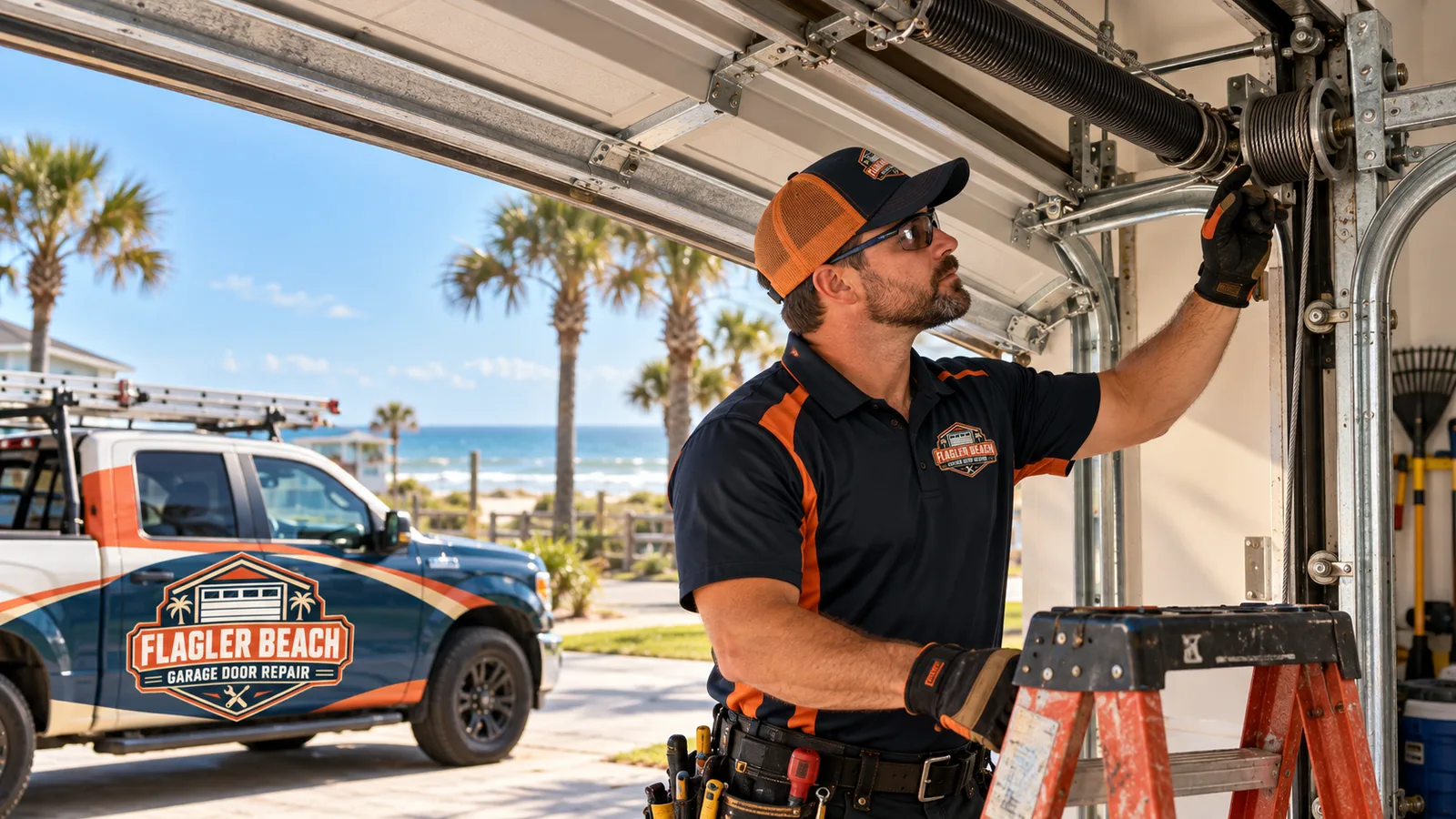
Emergency garage door repair in Flagler Beach
Help for stuck, off-track, or damaged garage doors in Flagler Beach.
Stop and assess the failure
When a garage door is stuck open or too heavy to lift, the problem affects security, access, and safe use of the garage. Emergency garage door repair in Flagler Beach, FL starts with identifying what failed rather than repeatedly pressing the opener or forcing the door by hand. Flagler Beach Garage Door Repair handles urgent faults involving springs, cables, rollers, tracks, openers, and safety components.
Stop operating the door if a cable is loose, a spring has separated, a roller has left the track, or the door hangs unevenly. A typical residential door weighs far more than a person should try to control without the spring system working. Keep children, pets, vehicles, and stored belongings away from the opening. If the door is open, do not stand beneath it or pull the emergency release unless the door is already supported and can be controlled safely.
A careful diagnosis distinguishes a mechanical failure from a power, control, or sensor problem. That matters because a door that will not close due to misaligned photo eyes requires a different repair than one that cannot lift because a torsion spring has broken. For nonurgent problems and planned maintenance, garage door repair in Flagler Beach covers the wider range of repair needs.
Garage door stuck or unsafe in Flagler Beach?
CALL NOW: (386) 517-6766Common urgent failures
A separated torsion spring may leave a visible gap in the coil, while a failed extension spring may hang loose beside the horizontal track. The opener should not be used to lift a door whose spring system has failed.
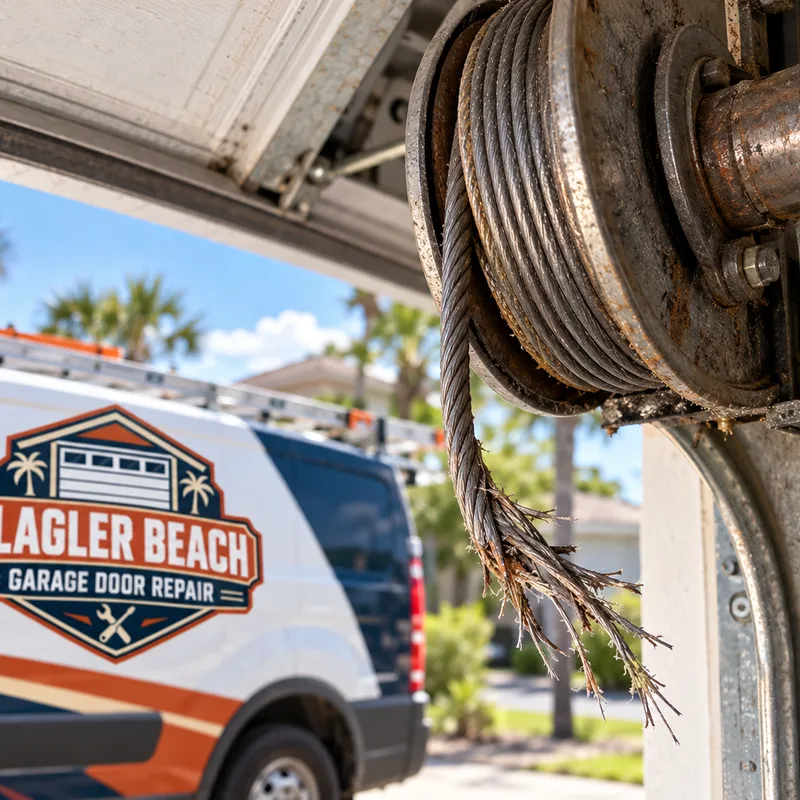
Lift cables carry tension and help keep the door level. A frayed, loose, or broken cable can make one side rise faster than the other and may cause the door to bind.
Bent track, damaged rollers, cable trouble, or an impact can pull part of the door out of alignment. Operating it again may worsen damage to the panels and hardware.
A door that cannot close leaves the garage exposed. The cause may be damaged hardware, an obstruction, track misalignment, opener trouble, or a safety-reversal fault.
Motor noise without door movement can point to a disconnected trolley, stripped drive components, a broken spring, or a door that has become mechanically jammed.
Photo-eye alignment, an obstruction, force settings, track resistance, or damaged hardware can trigger reversal. Safety devices should be tested rather than bypassed.
Safe observations before service
A few observations can help describe the problem without touching high-tension parts. Note whether the door is fully open, fully closed, or crooked. Look from a safe distance for a gap in the spring, a loose cable, a roller outside the track, or a bent section of track. If the opener has power, record whether it hums, moves the trolley, flashes its light, or does nothing.
For a door that refuses to close, remove objects from the opening and wipe dirt from the photo-eye lenses. The sensors are normally mounted near the floor on both sides of the opening. Do not tape them together, hold them out of position, or defeat the reversal system. If a hurricane-rated or wind-load door has damaged panels or reinforcement hardware, avoid forcing it into place because its bracing and attachment points are part of the assembly.
Flagler Beach has a salt-air environment that can accelerate corrosion on exposed steel hardware. Rust, pitting, and frayed cable strands deserve attention because they can weaken moving parts. After coastal storms, inspect the opening from a safe position for debris and visible impact damage before attempting operation.
From description to safety testing
Describe where the door stopped, whether it is level, what sound it made, and whether a spring, cable, roller, or track looks damaged. Mention if a vehicle is trapped or the opening cannot be secured.
Stop using the wall control and remote. Keep everyone away from the door's path, and do not loosen brackets, cable drums, bottom fixtures, or spring hardware.
The door, tracks, rollers, hinges, spring system, lift cables, opener connection, and safety reversal are checked to locate the primary fault and any related damage.
The needed work depends on the diagnosis. A repair may involve replacing a failed component, restoring alignment, correcting track or hardware problems, or addressing an opener fault.
After repair, the door should move through its full travel without binding. Balance, cable position, hardware, opener operation, photo eyes, and reversal behavior are checked as applicable.
Springs carry the door's weight
Garage door springs counterbalance the weight of the door. When the system is correctly matched and adjusted, the opener guides movement rather than carrying the full load. If a torsion spring breaks or an extension spring fails, the door may become extremely heavy, rise only a short distance, or tilt as it moves.
Do not assume a larger opener will solve a heavy door. An opener is not a substitute for working springs, intact cables, correctly seated rollers, and sound tracks. Continuing to operate the motor against a failed spring can damage the trolley, rail, gear assembly, or door sections.
Spring and cable work is not a safe do-it-yourself repair. Torsion springs store substantial energy, and bottom brackets may remain under cable tension even when the door appears stationary. Proper service requires identifying the door's spring configuration, securing the door, using the correct winding procedure and tools, and checking balance after the repair. If two torsion springs share the load and one has failed, the condition of the full system should be evaluated before parts are selected.
Urgent repair inspection
The inspection follows the complete operating path: panels and hinges, rollers and tracks, springs and lift cables, opener connection, photo eyes, and safety-reversal behavior.
Safety and next steps
Keep people away from the opening, stop using the opener, and arrange an inspection so the cause can be identified. Do not pull on loose cables or try to force the door down. Salt exposure and storm-blown debris can affect coastal garage door hardware, so mention any recent impact, corrosion, or obstruction when describing the failure.
A garage door with a broken spring should generally remain where it is until the system can be assessed. The door may be too heavy to control, and lifting it unevenly can displace cables or rollers. Do not rely on the opener to carry the door's unsupported weight.
An uneven door often points to a cable, drum, roller, track, or spring problem. Stop operation because continued movement can wedge the door in the opening and damage panels or hardware. A technician should secure the door and inspect both sides before attempting to restore alignment.
No, a door that will not close may have a blocked or misaligned photo eye, track resistance, damaged hardware, incorrect travel settings, or an opener fault. The mechanical door and safety-reversal system should be checked before the opener is condemned.
Minor track misalignment may be correctable, but severely bent, torn, or impact-damaged track may need replacement. The decision depends on the damage location, whether rollers can travel safely, and whether the mounting surface and door sections remain sound.
Do not pull the emergency release if the door is open, crooked, unusually heavy, or unsupported. Disconnecting the trolley can allow a door with failed springs or cables to move suddenly. Leave the system alone and keep the area clear until it can be secured.
A stuck or unsafe garage door needs an inspection.