Motor runs but the door stays put
A stripped drive gear, disconnected trolley, failed sprocket assembly, or damaged belt or chain can let the motor run without moving the door. Testing pinpoints where motion stops.
Serving Flagler Beach, Florida & surrounding areas
Garage door opener repair in Flagler Beach
Help for openers that will not run, reverse, make noise, or stop responding.
Start with the full system
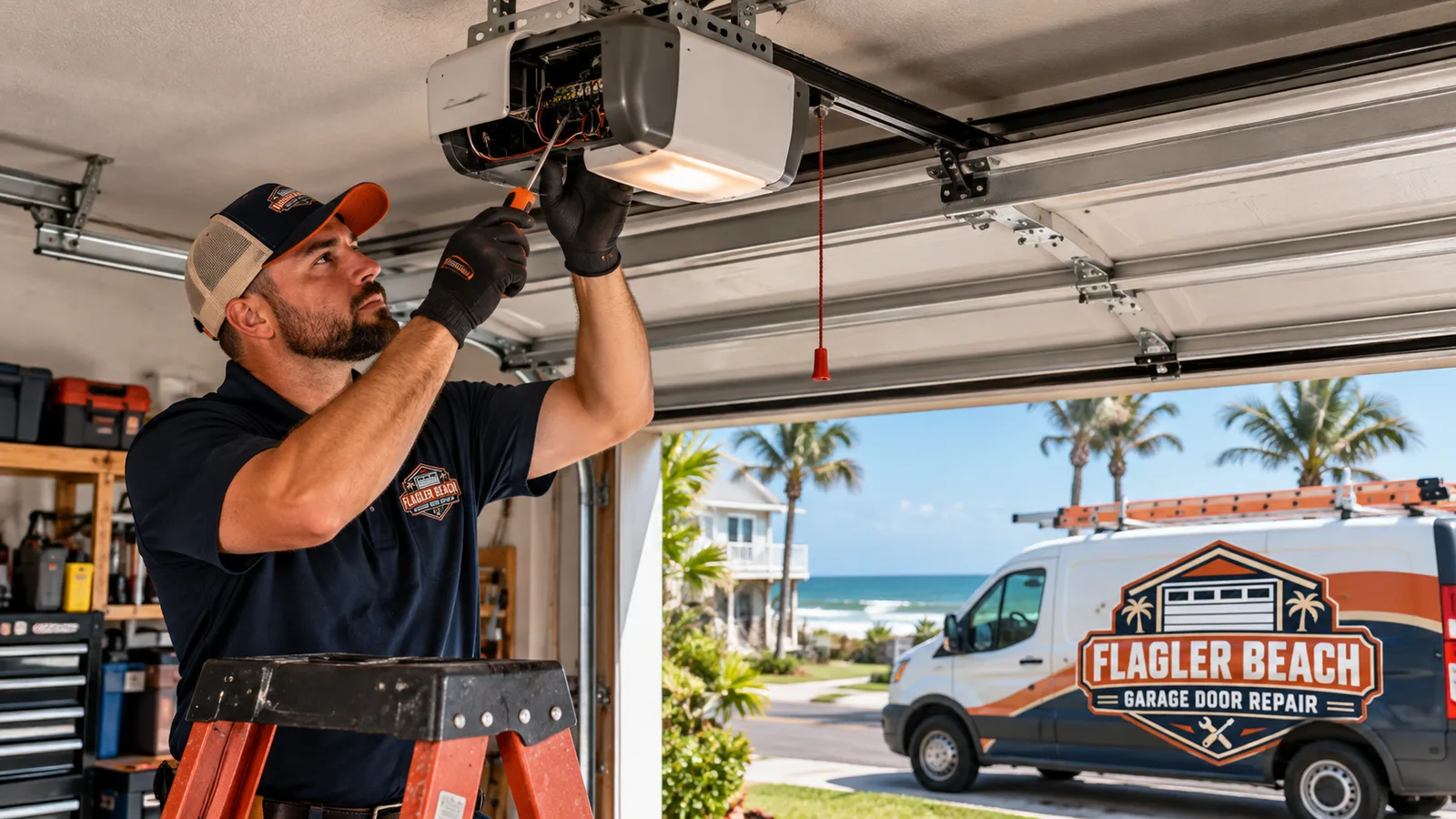
Garage door opener repair in Flagler Beach, FL starts by separating an opener problem from a door problem. A motor may hum because its internal drive gear is worn, but it can also struggle because the door is binding or poorly balanced. Flagler Beach Garage Door Repair checks how the door moves, listens to the motor, tests the controls, and inspects the safety system before recommending work.
Salt-laden coastal air can contribute to corrosion on exposed connectors, brackets, fasteners, and photo-eye hardware. Wind-driven moisture and debris may also affect sensors installed close to the garage opening. Those conditions make visual inspection and careful testing more useful than replacing parts based on one symptom.
The goal is straightforward: identify the failed component, confirm that the door itself can travel safely, and explain whether repair or opener replacement is the sensible next step. If the trouble involves hinges, rollers, cables, springs, or the door rather than the operator, garage door repair in Flagler Beach addresses that mechanical scope.
Garage door opener not responding in Flagler Beach?
CALL NOW: (386) 517-6766Symptom-based testing
A stripped drive gear, disconnected trolley, failed sprocket assembly, or damaged belt or chain can let the motor run without moving the door. Testing pinpoints where motion stops.
The cause may be a depleted battery, lost programming, radio interference, a damaged remote, keypad failure, or a receiver issue inside the opener.
Loose low-voltage wiring, a worn control button, lock mode, or a failing logic board can interrupt commands. The control circuit should be checked before parts are ordered.
Misaligned photo eyes, dirty lenses, damaged sensor wiring, incorrect travel settings, or resistance in the door can trigger reversal. The safety system should never be bypassed.
Unusual sound can point to a motor capacitor, internal gear, travel module, trolley, or logic-board problem. Door weight and balance must also be ruled out.
Diagnostic light patterns, sensor status LEDs, control settings, and compatible bulbs provide useful clues. The meaning varies by opener brand and model.
Follow the operating chain
An automatic opener is a system of connected parts. The ceiling-mounted operator contains the motor and control electronics. A chain, belt, or screw drive transfers movement along the rail, while the trolley connects that movement to the door. Wall controls, remotes, wireless keypads, travel limits, force settings, and photoelectric sensors govern operation.
A proper inspection follows that chain. If a remote fails but the wall control works, attention turns to the remote battery, programming, receiver, or interference. If every control activates the motor but the trolley does not travel, the drive system becomes the likely area of concern. If the door moves partway and reverses, sensor alignment, travel settings, and physical resistance all need to be tested.
Flagler Beach Garage Door Repair also checks the manual release and the opener's attachment points. A loose header bracket or rail support can create movement and noise that resemble internal motor trouble. Any adjustment must preserve the manufacturer's safety functions, including the photo eyes near the floor and automatic reversal when the closing door meets an obstruction.
Diagnosis to verification
Share what happens when the remote, keypad, and wall control are used. Mention flashing lights, unusual sounds, intermittent operation, recent power loss, or whether the problem began after the door was struck.
The door is disconnected from the trolley when appropriate and moved manually. This helps reveal binding, excess weight, track resistance, or a balance issue that could overload the opener.
Remotes, wall controls, keypad input, photo-eye alignment, wiring, travel limits, and reversal behavior are checked. Diagnostic codes are considered according to the opener's make and model.
The rail, trolley, drive components, motor assembly, capacitor, receiver, and logic board are narrowed down as the symptoms require. The inspection avoids treating several unrelated parts as one failure.
Flagler Beach Garage Door Repair explains the affected component and the proposed scope. Opener age, parts compatibility, safety functions, and door condition all inform the decision.
After approved work, controls are programmed as needed and the door is cycled. Travel, stopping position, sensor response, manual release, and automatic reversal are checked before completion.
Choose the sensible scope
Repair is often reasonable when the fault is isolated, the correct part is available, and the opener otherwise operates safely. A damaged remote, loose sensor connection, worn gear, faulty wall control, or failed capacitor may not justify replacing the entire unit.
Replacement deserves consideration when several major components are failing, the rail or drive assembly is badly worn, compatible parts are unavailable, or the operator lacks working photoelectric safety sensors. Persistent electrical damage after a surge may also make extensive board-level repair poor value. A new opener should be selected for the door's size, weight, construction, and expected use rather than chosen by motor labeling alone.
A weak or noisy opener is not always the root problem. Garage door springs counterbalance the door's weight, and the opener is meant to guide a balanced door rather than lift excessive dead weight. Installing a stronger operator without correcting a heavy, binding, or damaged door can shorten the life of the new equipment.
Control behavior, diagnostic lights, sensor status, rail movement, door balance, and the opener model help narrow the fault without guessing.
Controls, sensors, and drive systems
The opener may be detecting an obstruction, sensor fault, incorrect travel setting, or resistance in the door. Clean both photo-eye lenses, remove objects near the opening, and check whether each sensor has a steady indicator light. Coastal moisture and corrosion around low-mounted brackets or wire connections can also cause intermittent sensor trouble in Flagler Beach. Do not bypass the photo eyes; they are part of the closing safety system.
Yes, this symptom is often repairable if the fault is a worn drive gear, damaged sprocket, disconnected trolley, or failed belt or chain component. The door must also be tested by hand because a broken spring or binding door can overload the operator. The correct repair depends on where motion stops between the motor, rail, trolley, and door arm.
Short remote range can result from a weak battery, radio interference, antenna damage, an incompatible LED bulb, a failing remote, or receiver trouble. Testing another control and checking the hanging opener antenna helps narrow the cause. Battery replacement and reprogramming are sensible first steps, but repeated loss of range may require electrical diagnosis.
A new remote will work only if its radio system and programming method are compatible with the opener. Brand name alone is not enough because manufacturers have used different frequencies and security protocols over time. The opener's model number and learn-button details are used to identify a suitable remote or universal control.
The automatic closing function should not be used with defeated or bypassed photo eyes. First check for blocked lenses, loose brackets, direct damage, and low-voltage wiring problems near the garage opening. Flagler Beach Garage Door Repair can test whether alignment, wiring, a sensor pair, or the operator's control board is responsible.
The opener brand and model, approximate age, drive type, and exact symptoms are the most useful details. Note whether the wall button, remote, and keypad behave differently, and count any flashing diagnostic lights if possible. A photo of the model label can help identify compatible parts without guessing.
An opener that starts, stops, or reverses unpredictably deserves a full diagnosis before another part is installed. Describe the symptoms and get a practical plan for the motor, controls, drive system, or safety sensors.
CALL NOW: (386) 517-6766An opener that does not operate the door correctly needs an inspection.